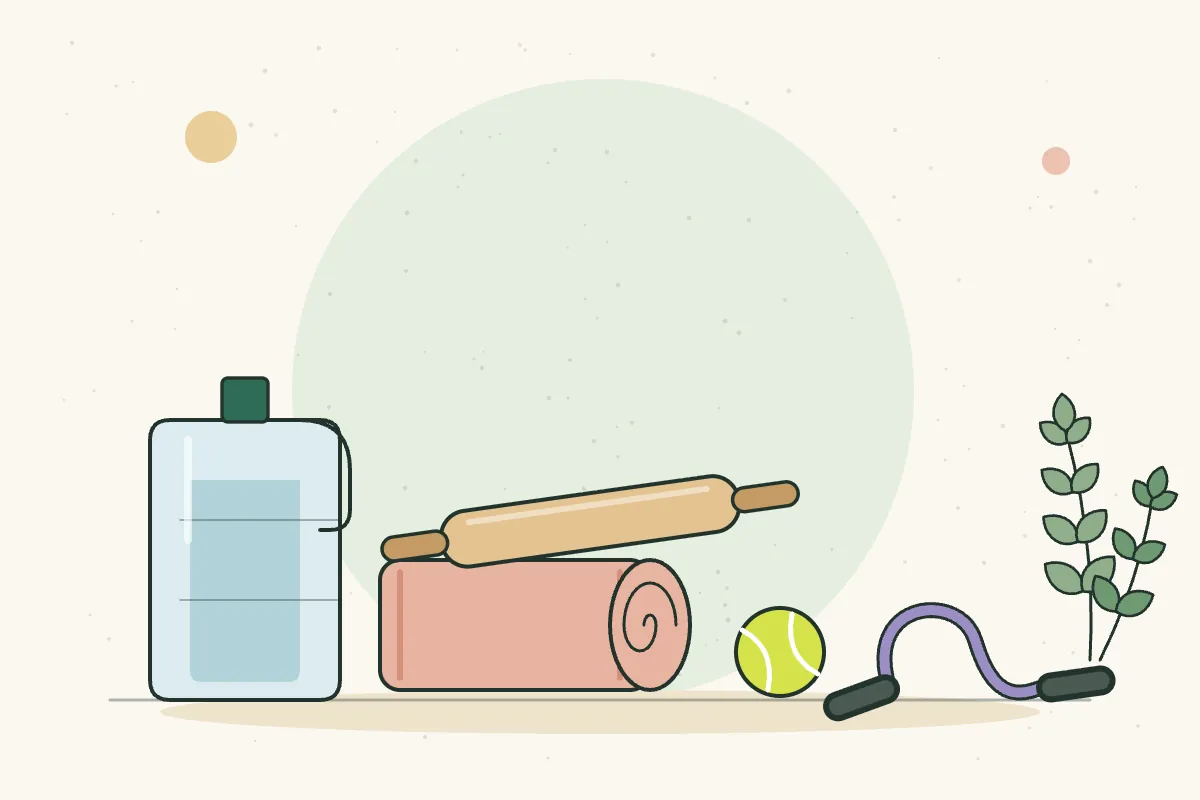
You can build a useful home workout kit from things you already own: towels for stretching and sliding, water jugs as weights, a rolling pin or tennis ball for self-massage. The one thing not worth improvising is the elastic band itself. Homemade bands from bungee cords, old inner tubes or knotted elastic can snap or slip and hit you in the face, and proper bands are inexpensive and widely available.
The short version
- Good DIY swaps: towels and sheets, water bottles and jugs, a backpack with books, a rolling pin, tennis or lacrosse balls.
- Do not make elastic bands from bungee cords, bike inner tubes or rubber you cannot vouch for. Snapping elastic can injure eyes.
- A PVC pipe can work as a firm roller but is hard on the body. Wrap it and start gently.
- Buy real bands once you train with resistance regularly, and inspect them before every session.
Why go DIY at all?
To get the benefits of strength training, your muscles need resistance, and that resistance does not have to come from a gym. Federal activity guidelines recommend muscle strengthening on at least two days a week, and bodyweight exercises plus simple household objects are enough for most beginners. DIY gear is also a low-commitment way to find out whether you will actually use equipment before you buy it.
Resistance band alternatives that are actually safe
The trick is to use things that do not store elastic energy. A towel will not fly back at you if it slips. A stretchy cord will.
Towel or bedsheet
A bath towel is one of the most versatile tools you own. Use it for:
- Stretching: loop it around your foot while lying on your back to stretch the hamstrings, or hold it behind your back for a shoulder stretch.
- Self-resisted rows and curls: stand on the middle of a towel and pull up on both ends while resisting with your legs, or loop it around a sturdy post and lean back for a row.
- Sliders: on hardwood or tile, a small towel under your feet turns lunges, mountain climbers and hamstring curls into harder exercises.
Belt or yoga strap
A plain belt without elastic works like a towel for stretching and gives you a longer reach. Keep the buckle away from your face.
Water bottles, jugs and backpacks
Water is easy to dose. A full gallon jug of water weighs about 8.3 pounds (3.8 kg), a half gallon about 4 pounds (1.9 kg). Use bottles or jugs with solid handles for curls, shoulder presses, rows and goblet squats. A backpack filled with books or bags of rice makes a decent weighted vest for squats, step-ups and lunges. Keep the load close to your back and pack it tightly so it does not shift.
Furniture and stairs
A sturdy chair or the bottom stair works for step-ups, incline push-ups and triceps dips. Make sure the chair cannot slide or tip, ideally pushed against a wall.
Safety first: never DIY the elastic
- No bungee cords. The metal hooks become projectiles if the cord slips or breaks.
- No old bike inner tubes or random rubber. Rubber ages, cracks and can tear without warning, and you cannot know its condition.
- No knotted elastic or tied-together bands. Knots slip under tension.
- Protect your eyes. Even with store-bought bands, never anchor or pull them toward face height in a way that could snap back at your eyes.
- Latex allergy: many bands contain latex. Choose latex-free bands if you are allergic.
Foam roller alternatives
Foam rolling is a form of self-massage. Reviews of the research suggest it can briefly improve range of motion and reduce how sore you feel after exercise, though the effects are modest and short-lived. If you want to try it before buying a roller, these options work:
- Rolling pin: good for calves, thighs and forearms while seated. You control the pressure with your hands.
- Tennis ball: softer, good for the soles of the feet, glutes and the muscles around the shoulder blades (place it against a wall, not the floor, to start).
- Lacrosse ball: much firmer. Use it only after you are comfortable with a tennis ball.
- Frozen water bottle: rolling it under the arch of the foot feels soothing after a long day on your feet.
- Tightly rolled yoga mat or towel: a soft roller for the upper back or as support under the spine for chest opening.
What about a PVC pipe roller?
A piece of PVC pipe from the hardware store is a popular DIY roller, but it is much harder than foam. Problems are bruising, pain and rolling too hard over sensitive areas. If you try it, choose a wide diameter pipe (about 4 inches or 10 cm), sand any sharp edges at the ends and wrap the pipe in an old yoga mat or thick towel secured with tape. Start with part of your body weight supported by your hands or the other leg.
- Go slow. Roll about an inch per second over the muscle for 30 to 60 seconds.
- Stay on muscle. Avoid rolling directly over joints, bones, the lower back (use a ball beside the spine instead, gently) and the front and sides of the neck.
- Breathe. Pressure should feel like a strong massage, around a 5 to 7 out of 10, never sharp.
- Skip injured spots. Do not roll over bruises, fresh injuries, varicose veins or any area with unexplained swelling.
When not to roll
Skip self-massage on a calf or leg that is suddenly swollen, warm, red or painful, which can be a sign of a blood clot and needs prompt medical attention. People with osteoporosis, bleeding disorders, those taking blood thinners, and anyone who is pregnant should ask their doctor or physical therapist before using firm rollers or balls.
When to buy real equipment
DIY works well for getting started, but buy proper gear when:
- You train with resistance two or more times a week and want progressive resistance. A set of bands in several strengths is the easiest way to keep progressing at home.
- You want handles, door anchors and loops designed to hold under load.
- Your household items become too light, or awkward shapes start to hurt your grip or form.
- You want a roller with consistent firmness rather than a hard pipe.
Whatever you buy, inspect bands for nicks, thin spots and stickiness before each session, store them out of direct sunlight, and replace them at the first sign of wear.
A simple starter routine
Twice a week: goblet squats with a water jug, towel rows around a sturdy post, incline push-ups against the kitchen counter, backpack step-ups on the bottom stair. Two to three sets of 10 to 15. Our article on short workouts has more ideas for fitting it in.
Frequently asked questions
Can I use pantyhose or stretchy fabric as a resistance band?
For gentle physical therapy style moves with very little tension, some people do, but the resistance is weak and unpredictable. For real strength work, a proper band is safer and more effective.
Is a rolling pin as good as a foam roller?
For legs and arms it works well, and you can control the pressure precisely. For the back, a floor roller or a ball against the wall is easier.
How heavy should my water jug weights be?
Choose a weight you can lift 10 to 15 times with good form, where the last few reps feel challenging. Adjust by filling bottles more or less.
Sources
- US Department of Health and Human Services: Physical Activity Guidelines for Americans, 2nd edition
- Mayo Clinic: Strength training, how-to video collection
- American Academy of Ophthalmology: Eye injury prevention
- Systematic reviews on foam rolling and range of motion, published in sports medicine journals
- Cleveland Clinic: Deep vein thrombosis (DVT) symptoms
Comments
No comments yet. Tried this at home? Tell us how it went.